x
Subscribe to our blog
Posted 4 February 2026 by
Nathalie Ooms
Senior Change Management & Communication Consultant

5 Reasons your project still fails even when the KPIs look good 

Most organizations love their KPIs, and rightly so. They track progress, quantify success, and keep performance visible. Yet many organizations recognize a painful reality: even when every KPI is green, the project still fails to create measurable business change

KPIs absolutely have their place, but only if we understand their limitations. Real success happens when measurement drives action. We help our clients turn metrics into momentum by connecting performance indicators to strategic objectives and the behaviors needed to achieve them. 

Curious how to move beyond green dashboards and make change stick by aligning teams, inspiring action, and embedding sustainable change that actually lasts across the organization? Keep reading to uncover the most common reasons we see at our clients why projects still fail, even when the KPIs look good. 


In a rush? Here are the 3 key takeaways

  1. 👉 While KPIs are valuable for tracking performance, without clear objectives (OKRs), organizations risk misalignment, short-term focus, and an overemphasis on metrics.
  2. 👉 OKRs help teams define the why and what impact behind their efforts. They drive organizations to focus on end-user value and continuous improvement.
  3. 👉 Embedding OKRs into project and change management aligns delivery (what gets done) with adoption (how people work differently).


1. You focus more on delivery than on adoption  

Successful transformation does not end with delivery. A project does not succeed because a tool goes live or a process is documented. It succeeds when people actually adopt the change and sustain it over time. 

True impact is achieved when new ways of working become part of everyday behavior, long after the project team has moved on. That requires intentional change activities and milestones that track not only what is delivered, but how people work differently as a result. 

This dual focus shifts projects from being output-driven (“we delivered the solution”) to impact-driven (“people work differently, and it sticks”).

2. You need to shift your mindset from output to outcome thinking

When setting KPIs, the focus is typically on output and task completion, measuring the overall success of the organization. KPIs are often used to monitor past performance and are primarily metric-driven, answering the question, “How are we performing?”.  

 They tend to rely on lagging indicators, reflecting results that have already occurred. 

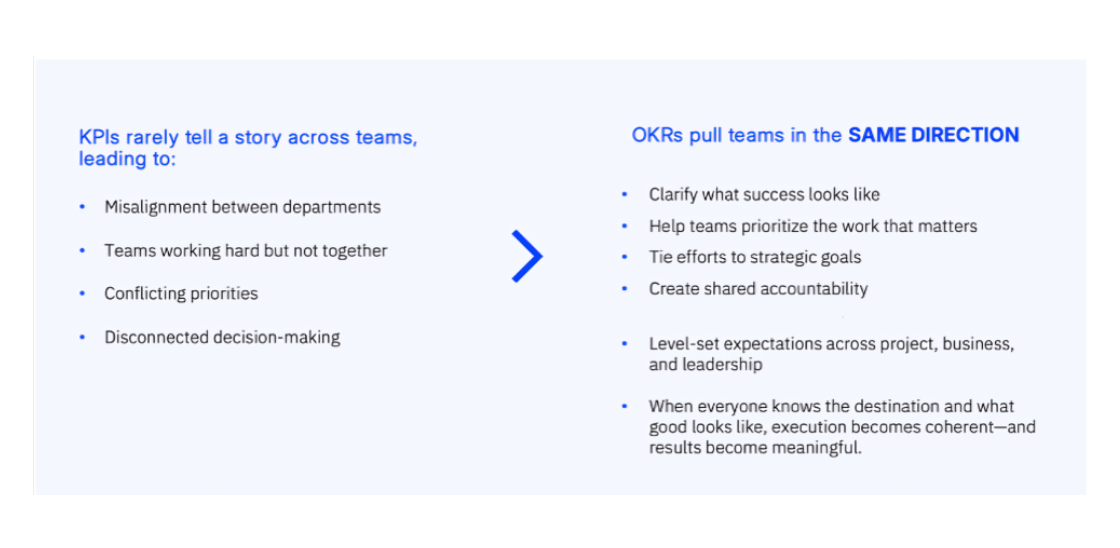
That’s where OKRs (Objectives & Key Results) come in. They shift the focus from output to outcome, from ticking boxes to creating tangible change. OKRs serve as a goal-setting framework that helps monitor achieved results and their real effects on how the organization operates. This approach is value-oriented, encouraging teams to ask “What outcome do we want to see?”. They define impact through: 

  • Objectives: What an organization or team aims to achieve. A clear, inspiring statement of intent that captures where you want to go. It’s qualitative, memorable, and energizing. 
  • Key Results: The measurable outcomes that indicate progress toward that goal. They translate ambition into action. 
KPI’s tell you how fast you are running, not whether you’re running in the right direction.

3. You are measuring performance without defining purpose 

In many organizations, measurement is disconnected from purpose. KPIs are monitored closely, yet the rationale behind them is rarely articulated. When teams cannot explain why a metric matters, measurement becomes an end in itself rather than a means to create value.  

KPIs track activity (response time, output, budget, accuracy, volume), but activity does not equal meaningful impact. This is where OKRs bring direction back into the project. By shifting the conversation from tasks to outcomes, they push teams to ask: 

  • Who are we creating value for? 
  • What do we want to see change? 
  • How will we know we made the intended impact? 

By continuously revisiting these questions, OKRs promote reflection and adaptation, ensuring that performance stays aligned with what truly matters.  

4. Your KPIs are siloed and reinforce short-term thinking

Most KPIs are designed within functional boundaries. They optimize individual performance but rarely encourage collaboration across teams. Over time, this creates strong local results and weak end-to-end outcomes. 

Short-term targets are met, dashboards turn green, yet cross-functional problems remain unsolved. 

By introducing shared objectives and outcomes, OKRs help organizations move from isolated performance to collective progress, balancing near-term execution with long-term value creation. 


5. You are confusing objectives with key result

When objectives and key results are mixed up, teams lose direction and start optimizing metrics instead of creating value. The result is the illusion of progress: numbers improve, but meaningful change does not happen. 

Objectives should be short, inspirational, and engaging. They describe ambition and direction, not something to be measured directly. Their role is to motivate and align. 

Key results, on the other hand, must be specific, measurable, and quantitative. They define what success looks like and how progress will be tracked. Each objective typically has two to five key results. 


Conclusion: how OKRs can empower your existing KPI framework

Many organizations put too much faith in KPIs. When measurement becomes the focus, projects can be delivered perfectly while real change never happens. Moving beyond green dashboards requires more than better metrics. It requires strong project management to deliver the right solutions and strong change management to ensure those solutions are actually adopted. 

At Bluecrux, we help organizations move past KPI-driven execution by strengthening both how projects are run and how change is embedded. Across supply chain transformations, from planning to manufacturing and logistics, we support our clients in turning delivery into adoption and metrics into real progress. Tools like OKRs are part of that journey, but never the goal. 

Curious about this topic?

Let’s have a chat!